
ONE MAN’S EVOLUTION IN CONSCIOUSNESS

Robert Francis Kennedy was born in 1925. He followed his older brothers, Joe and John, to Harvard, but had to settle for law school at the University of Virginia. He managed his brother John’s campaign for Senate in 1952 and then, with his father’s arrangement, went to work for senator Joe McCarthy. Two years later Kennedy served as chief counsel to the Senate committee that chastised McCarthy. From 1957-1959 he served as chief counsel to the U.S. Senate’s Select Committee on Improper Activities in Labor and Management. Nicknamed the McClellan committee after its chairman John L. McClellan, this committee investigated labor racketeering. Under Kennedy’s direction, the McClellan committee exposed the corruption and fraud, including the misuse of union pension funds, of the Teamsters Union, resulting in the conviction of its president, Dave Beck, and the indictment of his successor, Jimmy Hoffa.
Bobby Kennedy was not without a kind of legal experience on Capitol Hill, but his appointment as Attorney General in 1961 involved nepotism of the highest order. Joe Kennedy pushed both of his sons to make this appointment, and eventually both John and Robert went along. The precedent was cited by Richard Nixon when he appointed John Mitchell, his campaign manager in 1968 and 1972, to serve as his Attorney General. Nonetheless Bobby Kennedy arguably was one of the most significant members of his brother’s administration, offering him counsel and support that usually had positive results.
The assassination of President John Kennedy in November 1963 profoundly shattered Robert Kennedy, triggering intense personal grief, profound political disillusionment, and a persistent belief that he was partly responsible due to his anti-organized crime initiatives. He struggled with depression, withdrew from public life for a time, and secretly doubted the official investigation. In the weeks that followed, Robert Kennedy was a shattered man. His friend John Siegenthaler observed, “It was a physical blow to him, that loss of his brother. An emotional blow, intellectual blow, but it took a physical toll on him. He was physically in pain.”
Everyone who came in contact with Robert Kennedy in those days could see the loss etched in his face. He seemed wracked with “survivor guilt,” often wondering aloud why he—the Kennedy brother with the “ruthless” reputation—had not been killed instead. He was also haunted by his brother’s memory. He quoted Jack constantly in his public speeches. He adopted some of his physical mannerisms, such as stabbing a finger in the air for emphasis. He began wearing one of Jack’s old, worn-out tweed coats. Aides remember that he would sometimes leave it behind, as if trying to unburden himself, before sending one of them back to retrieve it.
Bobby and Jacqueline Kennedy, the two people who felt Jack’s loss most keenly, grew very close during this time. At her suggestion, he began reading the classics, finding solace in what the Greek dramatists and poets had to say about tragedy. Bobby often quoted Aeschylus by heart. One of his favorite passages, for obvious reasons, was this: “He who learns must suffer. And even in our sleep pain that cannot forget, falls drop by drop upon the heart, and in our own despair, against our will, comes wisdom to us by the awful grace of God.” He remembered the quote again on April 4, 1968, when he spoke extemporaneously to an audience in Indianapolis upon hearing the news that Martin Luther King, Jr. had been killed.
Turning inward in his grief, RFK was dealing not just with the loss of a brother, but of his own identity. For more than a decade, his career had been harnessed to his older brother’s. Jack’s goals were his goals; Jack’s problems were his as well. Now, he faced an existential but very real question: who was he and what would he do with his life? Biographer Jack Newfield puts it well: “During the months following the death of his brother, Robert Kennedy almost certainly experienced the classic identity crisis most of us go through during adolescence. For the first time he began to try to find out who he was—an exploration that was far from completed when he was shot down.”
RFK’s immersion in the classics makes sense: the ordeal he went through reads like a Greek tragedy. He was the dutiful brother forced to take the place of the slain king. Like most of Kennedy’s friends and observers, historian Ronald Steel saw his brother’s assassination as the transformative event in Robert Kennedy’s life.
“Only gradually and partially did he emerge from his grief. It left a melancholy that could be seen in his eyes, and it tempered his arrogance and impatience. Grief helped humanize him. It pulled him into the world of human imperfection and suffering. It even made him more tolerant. And it forced him, bit by bit, to begin the effort to reevaluate a life based on power, will, and the drive to conquer. It was during these months that the ‘new Bobby’ is said to have emerged from the chrysalis of the old,” Steel concludes. “This is where the legend of John Kennedy leaves off and the legend of Robert Kennedy begins.”
Kennedy ran for the US Senate from New York, admittedly as a carpetbagger, and defeated the moderate, pro-civil rights Republican incumbent, Ken Keating by more than 10%. As a US Senator from New York, Bobby Kennedy finally has his own platform, and he began to establish his own political identity.
In 1966 the anti-apartheid National Union of South African Students (NUSAS) invited Senator Kennedy to speak at the University of Capetown. Since he was a United States senator, the apartheid government allowed him entry to the country.
June 6, 1966 in Capetown
This is a Day of Affirmation – a celebration of liberty. We stand here in the name of freedom.
At the heart of that western freedom and democracy is the belief that the individual man, the child of God, is the touchstone of value, and all society, all groups, and states, exist for that person’s benefit. Therefore, the enlargement of liberty for individual human beings must be the supreme goal and the abiding practice of any western society.
The first element of this individual liberty is the freedom of speech; the right to express and communicate ideas, to set oneself apart from the dumb beasts of field and forest; the right to recall governments to their duties and obligations; above all, the right to affirm one’s membership and allegiance to the body politic – to society – to the men with whom we share our land, our heritage and our children’s future.
Hand in hand with freedom of speech goes the power to be heard – to share in the decisions of government which shape men’s lives. Everything that makes man’s lives worthwhile – family, work, education, a place to rear one’s children and a place to rest one’s head – all this depends on the decisions of government; all can be swept away by a government which does not heed the demands of its people, and I mean all of its people. Therefore, the essential humanity of man can be protected and preserved only where the government must answer – not just to the wealthy; not just to those of a particular religion, not just to those of a particular race; but to all of the people.
And even government by the consent of the governed, as in our own Constitution, must be limited in its power to act against its people: so that there may be no interference with the right to worship, but also no interference with the security of the home; no arbitrary imposition of pains or penalties on an ordinary citizen by officials high or low; no restriction on the freedom of men to seek education or to seek work or opportunity of any kind, so that each man may become all that he is capable of becoming.
These are the sacred rights of western society. These were the essential differences between us and Nazi Germany as they were between Athens and Persia.
They are the essences of our differences with communism today. I am unalterably opposed to communism because it exalts the state over the individual and over the family, and because its system contains a lack of freedom of speech, of protest, of religion, and of the press, which is characteristic of a totalitarian regime. The way of opposition to communism, however, is not to imitate its dictatorship, but to enlarge individual human freedom. There are those in every land who would label as “communist” every threat to their privilege. But may I say to you, as I have seen on my travels in all sections of the world, reform is not communism. And the denial of freedom, in whatever name, only strengthens the very communism it claims to oppose.
Many nations have set forth their own definitions and declarations of these principles. And there have often been wide and tragic gaps between promise and performance, ideal and reality. Yet the great ideals have constantly recalled us to our own duties. And – with painful slowness – we in the United States have extended and enlarged the meaning and the practice of freedom to all of our people.
For two centuries, my own country has struggled to overcome the self-imposed handicap of prejudice and discrimination based on nationality, on social class or race – discrimination profoundly repugnant to the theory and to the command of our Constitution. Even as my father grew up in Boston, Massachusetts, signs told him that “No Irish Need Apply”. Two generations later, President Kennedy became the first Irish Catholic, and the first Catholic, to head the nation; but how many men of ability had, before 1961, been denied the opportunity to contribute to the nation’s progress because they were Catholic, or because they were of Irish extraction? How many sons of Italian or Jewish or Polish parents slumbered in the slums – untaught, unlearned, their potential lost forever to our nation and to the human race? Even today, what price will we pay before we have assured full opportunity to millions of Negro Americans?
In the last five years we have done more to assure equality to our Negro citizens and to help the deprived, both white and black, than in the hundred years before that time. But much, much more remains to be done.
For there are millions of Negroes untrained for the simplest of jobs, and thousands every day denied their full and equal rights under the law; and the violence of the disinherited, the insulted and the injured, looms over the streets of Harlem and of Watts and Southside Chicago.
But a Negro American trains as an astronaut, one of mankind’s first explorers into outer space; another is the chief barrister of the United States government, and dozens sit on the benches of our court; and another, Dr. Martin Luther King, is the second man of African descent to win the Nobel Peace Prize for his non-violent efforts for social justice between all of the races.
We have passed laws prohibiting discrimination in education, in employment, in housing; but these laws alone cannot overcome the heritage of centuries – of broken families and stunted children, and poverty and degradation and pain.
So the road toward equality of freedom is not easy, and great cost and danger march alongside all of us. We are committed to peaceful and non-violent change and that is important for all to understand – though change is unsettling. Still, even in the turbulence of protest and struggle is greater hope for the future, as men learn to claim and achieve for themselves the rights formerly petitioned from others.
And most important of all, all the panoply of government power has been committed to the goal of equality before the law – as we are now committing ourselves to achievement of equal opportunity in fact.
We must recognize the full human equality of all of our people – before God, before the law, and in the councils of government. We must do this, not because it is economically advantageous – although it is; not because the laws of God command it – although they do; not because people in other lands wish it so. We must do it for the single and fundamental reason that it is the right thing to do.
An eloquent articulation of the most positive elements of the mental/modernist consciousness stage as manifested in governance.
Bobby Kennedy first criticized President Johnson’s war in Vietnam in February 1966. Over the next two years his criticism intensified. Kennedy considered challenging Johnson’s renomination in 1968, but he wavered. A relatively unknown senator from Wisconsin, Eugene McCarthy, did declare his candidacy, entered the New Hampshire primary against LBJ, and won 41.9% of the vote to Johnson’s 49.6%. This outcome was viewed as a striking defeat for an incumbent President.
The primary was held on March 12. Four days later Bobby Kennedy announced his own campaign for the Presidential nomination. This decision angered the McCarthy campaign and for a time divided the anti-war Democrats into two camps.
On April 4, 1968, Martin Luther King was killed in Memphis. That evening Bobby Kennedy spoke to a crowd composed of both African Americans and whites in Indianapolis.
“I have bad news for you, for all of our fellow citizens, and people who love peace all over the world, and that is that Martin Luther King was shot and killed tonight.
Martin Luther King dedicated his life to love and to justice for his fellow human beings, and he died because of that effort.
In this difficult day, in this difficult time for the United States, it is perhaps well to ask what kind of a nation we are and what direction we want to move in. For those of you who are black--considering the evidence there evidently is that there were white people who were responsible--you can be filled with bitterness, with hatred, and a desire for revenge. We can move in that direction as a country, in great polarization--black people amongst black, white people amongst white, filled with hatred toward one another.
Or we can make an effort, as Martin Luther King did, to understand and to comprehend, and to replace that violence, that stain of bloodshed that has spread across our land, with an effort to understand with compassion and love.
For those of you who are black and are tempted to be filled with hatred and distrust at the injustice of such an act, against all white people, I can only say that I feel in my own heart the same kind of feeling. I had a member of my family killed, but he was killed by a white man. But we have to make an effort in the United States, we have to make an effort to understand, to go beyond these rather difficult times.
My favorite poet was Aeschylus. He wrote: ‘In our sleep, pain which cannot forget falls drop by drop upon the heart until, in our own despair, against our will, comes wisdom through the awful grace of God.’
What we need in the United States is not division; what we need in the United States is not hatred; what we need in the United States is not violence or lawlessness; but love and wisdom, and compassion toward one another, and a feeling of justice toward those who still suffer within our country, whether they be white or they be black.
So I shall ask you tonight to return home, to say a prayer for the family of Martin Luther King, that’s true, but more importantly to say a prayer for our own country, which all of us love--a prayer for understanding and that compassion of which I spoke.
We can do well in this country. We will have difficult times; we’ve had difficult times in the past; we will have difficult times in the future. It is not the end of violence; it is not the end of lawlessness; it is not the end of disorder.
But the vast majority of white people and the vast majority of black people in this country want to live together, want to improve the quality of our life, and want justice for all human beings who abide in our land.
Let us dedicate ourselves to what the Greeks wrote so many years ago: to tame the savageness of man and make gentle the life of this world.
Let us dedicate ourselves to that, and say a prayer for our country and for our people”
You can see this speech here:
On this night, in this intense emotional moment, Robert Kennedy spoke without a prepared script or even notes and accessed integral/authentic consciousness. Americans in the audience were centered in three distinct stages of consciousness: mythic/conformist/traditional, mental/modernist, and affiliative/postmodern. The integrality of Kennedy’s message engaged all of them.
On June 4, 1968, Bobby Kennedy was shot and killed. His assassination completed the project of killing the four most significant progressive American political leaders of the decade: John Kenendy, Malcom X, Martin Luther King, and Bobby Kennedy.
John Lewis was there, already a leader in his own right. Some years later he explained: “In 1968, during that brief campaign for the Democratic nomination, Robert Kennedy would say over and over again, ‘There must be a revolution.’ Not a revolution in the streets, but in the minds and hearts and souls of our people. He believed that. He wanted — not just to change laws — but he wanted to change people. He wanted to change the mind-set. He wanted to build a sense of community. Dr. King called it ‘the beloved community,’ some of us call it an interracial democracy, some of us call it one house, the American house. But he wanted to see all of us make that great leap. Under his leadership we would’ve made that great leap.” Change the mind-set, an evolution of consciousness.
Ronald Steel: “I think Bobby Kennedy continues to haunt our imagination because he represents what might have been. We can never be disillusioned, because it’s always in the unfulfilled future. He never failed, because he was denied the chance, of course. But he opened the sense of possibilities of change...He spoke in a language that people could find their hopes, and their dreams. And so, I think we’ll always read in Bobby Kennedy, not what was, or what failed to be, but what might have been.”
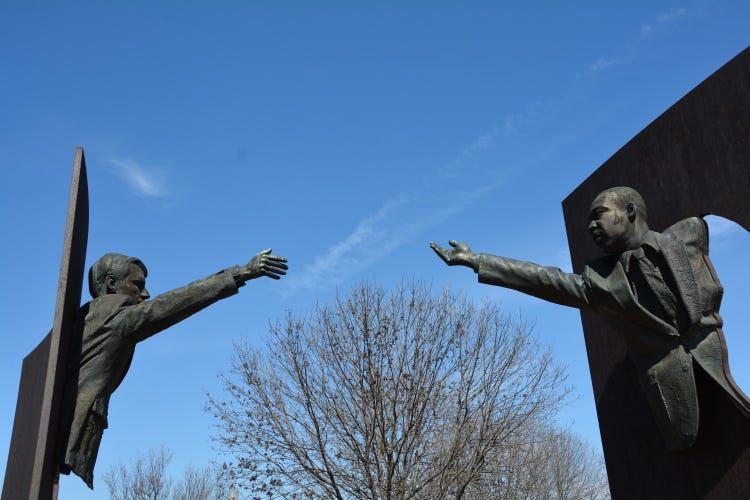
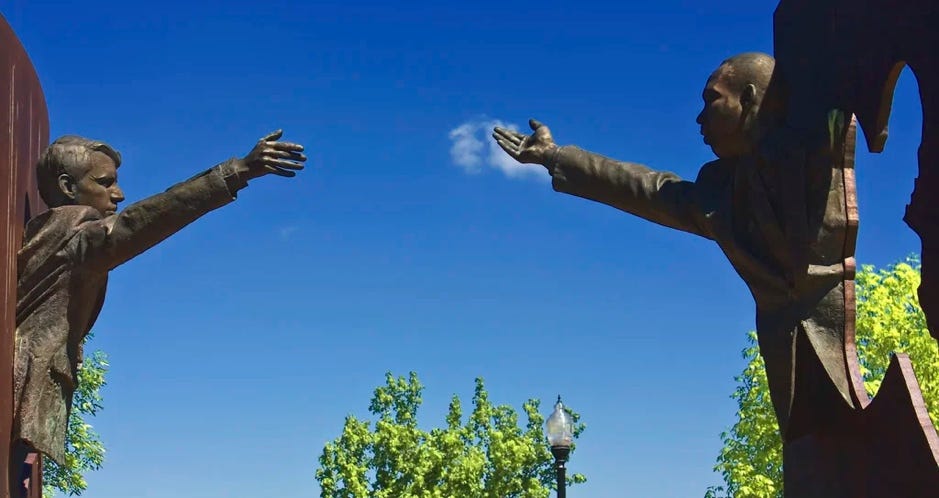
The Landmark for Peace Memorial in Indianapolis
very beautifully and heartfully written. Thank you.